Duolingo: Language & Chess

500M+
Installs
Duolingo
Developer
-
Education
Category
-
Everyone
Content Rating
-
super-support@duolingo.com
Developer Email
-
https://www.duolingo.com/privacy
Privacy Policy
Screenshots
editor reviews
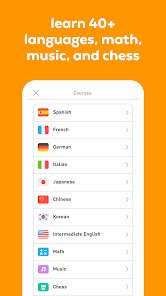
Duolingo is a language-learning app that thousands of people use to pick up new languages on their phones. You can download it for free from the Google Play or App Store—last I checked, it has over 500 million installs globally, which feels about right given how many friends I've seen using it. When you launch the app, you're greeted with a bright, playful interface full of cartoon characters and a green owl mascot that nudges you to start right away. No registration wall hits you hard; you just sign up with an email or Google account, and within minutes you're picking a language from a long list—Spanish, French, Japanese, and many others. The first impression is that it feels more like a game than a textbook, with colorful icons and quick prompts that make you want to tap through lessons immediately. There are some in-app purchases for perks like removing ads or getting unlimited hearts, but the free version is pretty generous for casual learners.
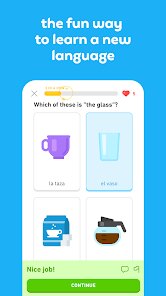
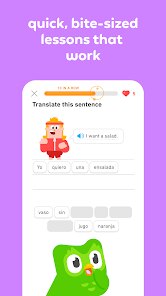
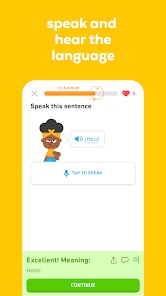
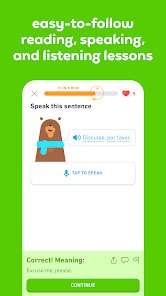
After you dive into actual use, the experience is surprisingly smooth. The app starts with a placement test if you have some background, but most beginners just begin from the first unit. The lessons are bite-sized, taking maybe 5-10 minutes each, and they mix reading, listening, speaking, and typing exercises. I found the onboarding intuitive: you tap on a lesson, see a word in English, choose the correct translation, or type what you hear from a native speaker audio clip. Sometimes you have to speak into the microphone to check pronunciation, which can be hit or miss in noisy places. The interface keeps things moving with progress bars, points, and virtual currency called lingots that you earn for streaks. A small tip I picked up: turning off sound effects in settings saves battery during long sessions. There are occasional moments of confusion when a lesson throws in grammar without explanation, but the app generally guides you forward without frustration.
After using Duolingo for a few weeks, I think it works best for casual learners who want to build basic vocabulary and stay consistent—the streak mechanic really hooks you to come back daily. It's not great if you need deep grammar rules or real conversation practice, since the exercises stay repetitive once you've done a few units. Compared to apps like Babbel or Rosetta Stone, Duolingo feels more like a game and less like a structured course, which is both its charm and its limit. The free version has ads, but they're not too intrusive, and I've kept it installed because it's a low-commitment way to maintain my Spanish over coffee breaks. Someone serious about fluency might uninstall it for more comprehensive tools, but for a quick, fun refresher, it sticks around on my phone.
features
- 😊 Gamified learning keeps you motivated with streaks, levels, and virtual lingots that reward daily practice, making it more engaging than Anki or Quizlet flashcards.
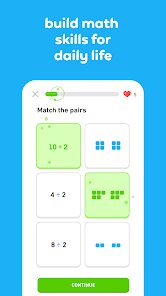
- 😊 The variety of exercise types—matching, translation, speaking, and listening—covers multiple skills within each lesson, unlike Memrise which focuses mostly on repetition.
- 😊 A huge language selection with over 30 options, including rarer ones like Navajo or High Valyrian, which gives it an edge over Babbel's more limited catalogue.
- 😊 Free core content with reasonable ad frequency, unlike subscription-heavy apps like Pimsleur, so you can learn a lot without spending anything upfront.
pros
- 👍 The cheerful, cartoony design and mascot make learning feel less intimidating, especially compared to serious apps like Busuu, which can feel like a chore.
- 👍 Strong community features, like leaderboards and clubs, push you to compete with friends, a social edge that apps like Mondly lack entirely.
- 👍 Excellent for building a base in a new language quickly—I could order food in Spanish after just a week, something I never got from Rosetta Stone's slow pace.
- 👍 The app works offline for downloaded lessons, a practical benefit over cloud-dependent apps like HelloTalk, perfect for subway commutes.
cons
- 👎 Repetitive exercise patterns get boring after a few units, unlike Babbel's varied dialogues that feel more natural for real conversations.
- 👎 Grammar explanations are often missing or too vague, forcing you to supplement with outside resources, whereas apps like Busuu offer clear grammar notes.
- 👎 The heart system (losing hearts for mistakes) can discourage progress, especially on tough lessons, while Anki lets you fail without penalties.
- 👎 Speaking exercises rely on limited voice recognition, so regional accents or background noise throw off accuracy, not as reliable as HelloTalk's human feedback.
Recommended Apps
![]()
16Personalities
16Personalities4
![]()
Zodiac Palm Reader: MagicWay
Reatility Media4.6
![]()
Moblo - 3D furniture modeling
MYTIforge4.1![]()
Magnifier Plus with Flashlight
Digitalchemy, LLC4.6![]()
QR Code Scanner
QR Code Scanner & Barcode Reader4.7![]()
FalFal: Astrology, Tarot, Love
FalFal Team4.8![]()
Christmas Photo Frames
PhotoFramesApps4.6![]()
AI Video Art Creator - Livensa
FERASET4.5![]()
Horoscope of Birth
Denimaks4.4![]()
Make Me Bald Prank
AppTornado2.5![]()
Kling AI: AI Image&Video Maker
Lohas Games Pte. Ltd.4.4![]()
Japan Timetable & Route Search
NAVITIME JAPAN CO., LTD.4.3![]()
Prank Call & Funny Video
TeH Software0![]()
Parallax 3D Live Wallpapers
TarrySoft4.3![]()
AI Chatbot - Nova
ScaleUp4.7














Disclaimer
1.AppInfoLibrary does not represent any developer, nor is it the developer of any App or game.
2.AppInfoLibrary provide custom reviews of Apps written by our own reviewers, and detailed information of these Apps, such as developer contacts, ratings and screenshots.
3.All trademarks, registered trademarks, product names and company names or logos appearing on the site are the property of their respective owners.
4. AppInfoLibrary abides by the federal Digital Millennium Copyright Act (DMCA) by responding to notices of alleged infringement that complies with the DMCA and other applicable laws.
5.If you are the owner or copyright representative and want to delete your information, please contact us info@appinfolibrary.com.
6.All the information on this website is strictly observed all the terms and conditions of Google Ads Advertising policies and Google Unwanted Software policy .