Miga Town

10M+
Installs
XiHe Digital (GuangZhou) Technology Co., Ltd.
Developer
-
Simulation
Category
-
Everyone
Content Rating
-
Support@xihegame.com
Developer Email
-
https://www.xihegame.com/privacypolicycn/
Privacy Policy
Screenshots
editor reviews
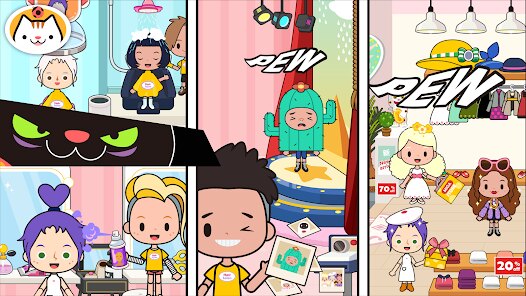
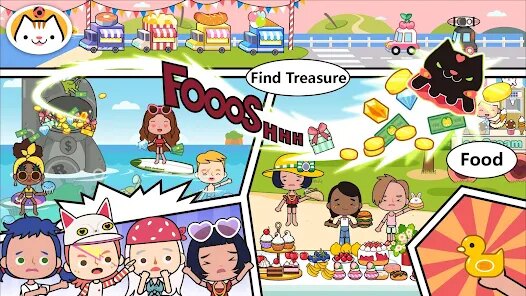
Alright, let's talk about Miga Town. If you're into digital dollhouses and open-ended, sandbox-style play, you've probably seen this around. It's essentially a "play house" simulator where you control little characters and interact with a variety of themed locations. Think of it as a super detailed, modern take on the classic dollhouse, but on your phone. This game is primarily a mobile experience, available for download on both the Google Play Store and the Apple App Store. While you won't find it on Steam or consoles like the Switch or Xbox, it's perfectly tailored for touchscreens. The first game in the series launched back in 2019, and since then, the developer has pumped out a ton of different "worlds". On Google Play alone, the main app has over 100 million installs, which is insane. It's free to download and play, but here's the catch: you get a couple of basic locations for free. To unlock the other themed worlds—like the hospital, school, or city—you'll need to make a one-time in-app purchase for each. They usually run about $3.99 USD per world. There are no in-app ads while you're playing, which is a huge relief, but those purchases can add up if you want the full collection.
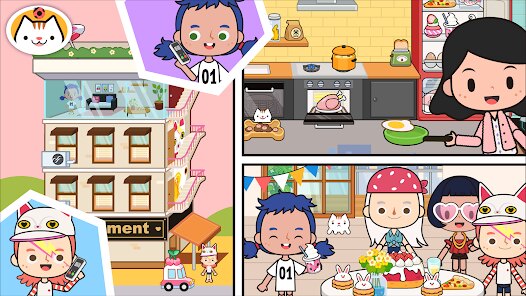
The gameplay is pure, unfiltered creativity. There are no points, no levels, and no timer. You drag and drop characters into a scene, and then you interact with almost everything. You can pick up a book and read it, turn on a stove, or have a character jump on a bed. The best part is the sheer freedom. You can make a character a doctor, then immediately have them cook a meal in the same hospital. There's no wrong way to play. My personal favorite part is the "Mall" world. I love picking a random character, giving them a bag, and just making them "shop" around. The level of detail in the items you can pick up—like checking a price tag on a shirt or smelling a candle—is surprisingly satisfying. I've spent hours just rearranging furniture or creating silly little stories between the characters. It's incredibly relaxing, almost meditative. You're not trying to win; you're just playing.
Compared to other games in this genre, like Toca Life World or the My Town series, Miga Town holds its own really well. While Toca Life World has a more vibrant, cartoonish art style and a smoother mechanic for connecting locations, Miga Town feels a bit more... detailed. The furniture and objects often have more interactive points, and the character customization is surprisingly deep. My Town games feel more like a straightforward dollhouse, whereas Miga Town often has little hidden interactions or "easter eggs" that make exploring fun. Why do I recommend it over the others? It's the cost model. You buy the specific worlds you want. I prefer paying $4 for a hospital world I'll actually use over a subscription model or a larger bundle. Plus, there are so many worlds—from a ski resort to a haunted house—that you can really tailor your app right to your own interests.
features
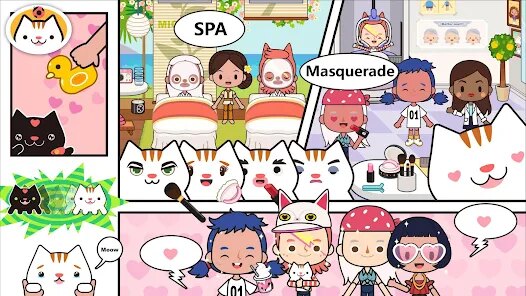
- Unique Character Faces 😄: Unlike the blank-faced avatars in Toca Life World, Miga Town characters have detailed, expressive faces and eyes. You can actually change their skin tone, hair color, and even their eye shape and expression. This makes role-playing feel much more personal and less generic.
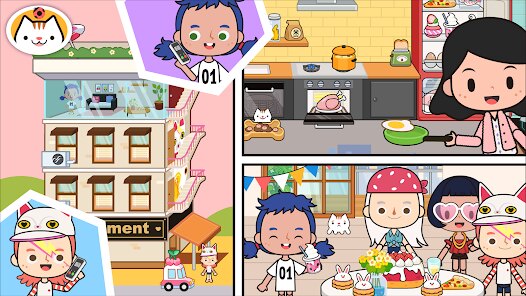
- Detailed Object Interactions 🛋️: This is the game's biggest win. You don't just tap a TV to turn it on; you can change the channel. You can open a fridge, take out a specific food item, and then cook it in a pan. My Town games often have one-tap interactions, but Miga Town lets you chain actions together for deeper pretend play.
- Multi-Touch Support ✌️: You can drag up to four characters at once with different fingers. This might sound simple, but it's a game-changer. It lets you have two characters high-five, or carry a conversation by moving their heads. It makes the storytelling feel fluid, unlike the clunkier single-character controls in many similar games.
pros
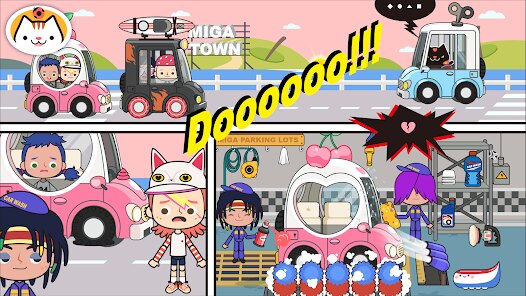
- Massive World Variety 🌎: The sheer number of different worlds is a huge strength. You have everything from a hospital and police station to a subway and a space center. Games like Toca Life: School are limited to one theme, but here you can build a whole interconnected universe by downloading multiple worlds into the same app.
- Lag-Free Performance 🚀: For a game with so many interactive items, it runs incredibly smoothly on my older Android phone. I've never experienced a crash or major stutter. Games like My Town: Daycare often have loading screens between rooms, but Miga Town is buttery smooth when moving characters between a house and a garden.
- No Timers or Ads 🚫: This is a huge deal for a kids' app. Once you buy a world, it's yours. There are no annoying timers to wait for or forced ads to watch like in Life is a Game. You can just play. This makes it a perfect offline game for flights or road trips.
cons
- Expensive to Complete 💸: Buying one world for $3.99 is fine. But if you want all 20+ worlds? You're looking at spending over $80. Games like Toca Life World offer a subscription that unlocks everything for a monthly fee, which is cheaper if you want the entire library. The a la carte model is great for picking a few worlds, but terrible for completionists.
- Can Be Repetitive 🔄: The core mechanic is exactly the same in every world. You drag characters, you tap objects. While the setting changes, the rules don't. After a few hours, the novelty wears off. Games like Honkai Impact 3rd or even Roblox offer more dynamic gameplay loops, where Miga Town can start to feel like a very pretty, very expensive series of loading screens.
- No Multiplayer Mode 🤝: This is a strictly solo experience. You can't share your town or invite a friend to play with you in real-time. Roblox has massive social worlds where kids interact and build together, but Miga Town feels isolated. You're just playing with your own characters in your own dollhouse, which gets lonely.
Recommended Apps
![]()
BMX Cycle Extreme Bicycle Game
PlayFlix4.7

![]()
Save the Doge
WONDER GROUP4.2![]()
Mystical Mixing
CrazyLabs LTD4.7![]()
Yarn Fever! Unravel Puzzle
Brave HK Limited4.7![]()
Steal n Catch the Brainrot
BMH VN Game4.4![]()
I Am Security
Estoty4.6![]()
Geometry Dash SubZero
RobTop Games4.5![]()
Soulmate Sketch
WhatsGood1.7![]()
Mini Block Craft 3D RealmCraft
Tellurion Mobile4![]()
MONOPOLY GO!
Scopely4.6![]()
FamilySearch Africa
FamilySearch International0![]()
Agent Hunt – Hitman Shooter
Homa4.5![]()
Hyper Heroes: Marble-Like RPG
HyperJoy3.5![]()
Brainrot Filter: Fun Challenge
Braly JSC0![]()
Shining Princess Style Hub
Happy Go Game4.4





Disclaimer
1.AppInfoLibrary does not represent any developer, nor is it the developer of any App or game.
2.AppInfoLibrary provide custom reviews of Apps written by our own reviewers, and detailed information of these Apps, such as developer contacts, ratings and screenshots.
3.All trademarks, registered trademarks, product names and company names or logos appearing on the site are the property of their respective owners.
4. AppInfoLibrary abides by the federal Digital Millennium Copyright Act (DMCA) by responding to notices of alleged infringement that complies with the DMCA and other applicable laws.
5.If you are the owner or copyright representative and want to delete your information, please contact us info@appinfolibrary.com.
6.All the information on this website is strictly observed all the terms and conditions of Google Ads Advertising policies and Google Unwanted Software policy .